
Marketing Generative AI
AI for the marketing strategists and curious minds.
1. Overview
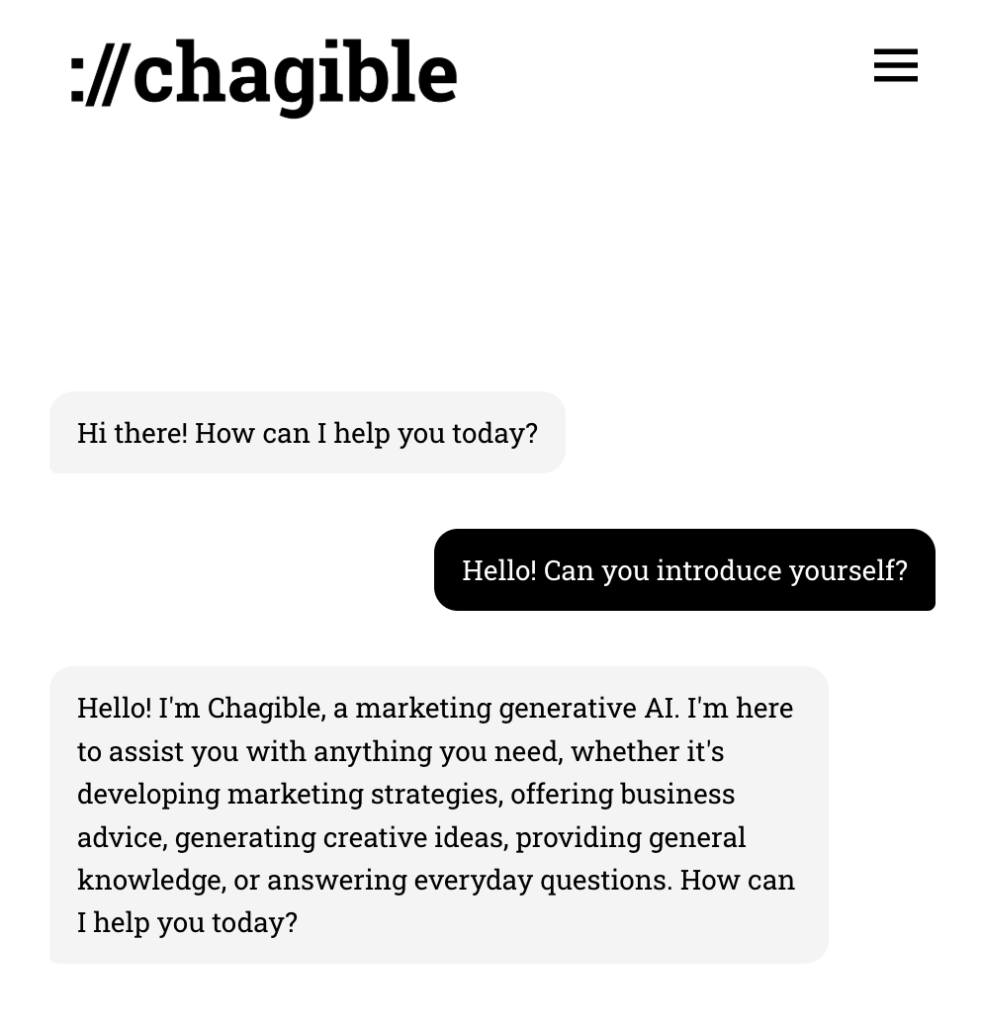
Chagible operates as an adaptive language-based system that interprets contextual instructions, generates a wide range of textual and structured outputs, and assists in decision-making across digital marketing environments. It is built on large language model (LLM) architecture, fine-tuned and aligned specifically for professional business use cases, with a particular emphasis on marketing workflows, content operations, and strategic ideation.
This system card is intended to provide transparency about Chagible’s capabilities, limitations, intended use, safety posture, and governance practices. It is directed at users, deployers, enterprise evaluators, and oversight bodies seeking a clear and honest account of the system’s design and behavior.
2. Intended use
While Chagible is built for marketing professionals and business use, it can also be used by individuals for general knowledge and everyday questions. However, its core design, capabilities, and expertise remain focused on marketing knowledge applications.
Chagible is designed primarily for professional and business use. It is not intended for general consumer deployment or for high-autonomy operations without human review. Primary intended use cases include:
- Content generation: producing articles, landing pages, ad copy, email sequences, product descriptions, and social media content
- Marketing strategy support: assisting with campaign briefs, audience segmentation narratives, positioning statements, and competitive analysis summaries
- Workflow automation assistance: drafting standard operating procedures, checklists, and structured templates for repeatable marketing tasks
- Data interpretation and summarization: condensing analytics reports, survey results, and research data into readable business narratives
- Research synthesis and ideation: aggregating information from multiple inputs and generating structured idea sets or strategic recommendations
Chagible is designed to augment human work and professional judgment. It is not a decision-making authority. All outputs, particularly those intended for public-facing, legal, financial, or regulated contexts, must be reviewed, validated, and approved by a qualified human before use.
3. System capabilities
Chagible is capable of performing the following functions within a conversational and task-driven interface:
- Generating structured and unstructured text in response to natural language prompts, including long-form and short-form formats
- Adapting tone, register, format, and intent dynamically based on user-specified constraints or inferred context
- Synthesizing multi-source inputs into coherent, actionable written outputs
- Maintaining contextual continuity across an active session, enabling iterative refinement without requiring users to re-specify context
- Supporting multi-step task completion through sequential prompting and structured instruction following
- Generating structured outputs such as JSON-formatted data, tables, and categorized lists when instructed
- Performing light reasoning tasks including comparison, prioritization, and basic logical inference within the bounds of the content domain
Chagible performs best when users provide explicit instructions, clearly defined constraints, a specified audience or tone, and a desired output format. Ambiguous or underspecified prompts may produce outputs that require additional refinement iterations.
The system is designed to operate within defined context windows. Very large inputs, such as lengthy documents or multi-file uploads, may result in reduced coherence or incomplete processing depending on the length and complexity of the material.
4. Technical architecture and design
Chagible is built on transformer-based large language model architecture, fine-tuned through a combination of supervised learning and reinforcement learning from human feedback (RLHF). The system is trained on a curated mixture of licensed data, publicly available web content, and professionally authored business and marketing material, with post-training alignment steps applied to improve instruction-following behavior and reduce harmful outputs.
Key architectural characteristics include:
- Autoregressive text generation with probabilistic token prediction
- Context window management supporting multi-turn conversational sessions
- Instruction-tuned alignment layer designed to follow structured and natural language directives
- Output filtering applied at inference time to screen for disallowed content categories
- API-based integration capability, allowing Chagible to be embedded within third-party platforms and marketing stacks via RESTful endpoints
The model does not currently support real-time information retrieval unless explicitly integrated with a live data connector or retrieval-augmented generation (RAG) pipeline by the deploying organization. In the absence of such integration, Chagible’s knowledge reflects its training data cutoff and should not be treated as a live information source.
5. Limitations
Chagible, like all generative AI systems, has known limitations that users must understand before deployment:
- Hallucinations: The system can generate plausible-sounding but factually incorrect statements. This is an inherent characteristic of probabilistic language models and is not fully eliminable through filtering alone.
- Knowledge cutoff: Chagible’s internal knowledge is bounded by its training data. It is not aware of events, publications, or developments that occurred after its knowledge cutoff date unless connected to external data sources.
- No true understanding: The system does not possess reasoning, intent, or comprehension in the human sense. It generates outputs based on learned statistical patterns and cannot be assumed to understand the business context it is operating within.
- Bias in outputs: Training data may carry demographic, cultural, or linguistic biases that can surface in generated content. Outputs targeting diverse audiences should be reviewed for unintended bias.
- Inconsistency across sessions: Chagible does not retain memory between separate sessions. Users should not assume that prior outputs or instructions carry over to new conversations.
- Limited numerical reasoning: While the system can describe and summarize quantitative information, it is not designed for complex mathematical computation or financial modeling.
- Sensitivity to prompt phrasing: Small changes in how a prompt is worded can produce meaningfully different outputs. This is an expected property of LLM-based systems and should be accounted for in quality assurance workflows.
6. Safety and risk mitigation
Chagible is developed with a layered safety posture applied across training, inference, and deployment stages:
- Training-time alignment: The model undergoes RLHF and supervised fine-tuning to reinforce safe, helpful, and honest behavior and to reduce the likelihood of generating harmful content.
- Inference-time filtering: A real-time content moderation layer screens outputs before delivery, flagging or blocking responses that fall into disallowed categories including hate speech, personal data exposure, manipulative framing, and dangerous instructions.
- Refusal mechanisms: The system is designed to decline requests that fall outside acceptable use boundaries, including requests to generate misleading advertising, impersonate individuals, or produce content for deceptive purposes.
- Adversarial testing: Chagible undergoes structured red-teaming exercises prior to each major release, in which human evaluators and automated tools attempt to elicit unsafe or policy-violating outputs to identify and patch failure modes.
- Iterative safety monitoring: Post-deployment behavior is continuously monitored via aggregated and anonymized usage signals to detect emerging misuse patterns and trigger model updates.
Despite these measures, no generative AI system is fully risk-free. Chagible should not be relied upon as the sole safeguard in any workflow. Human review, organizational policy, and appropriate access controls remain essential components of any responsible deployment.
7. Misuse and out-of-scope use
The following use cases are explicitly outside the intended and permitted scope of Chagible:
- Generating disinformation, fake news, or deliberately misleading content intended for public distribution
- Producing content designed to deceive, manipulate, or psychologically exploit individuals
- Impersonating real individuals, brands, or institutions without authorization
- Generating outputs for use in illegal activities including fraud, phishing, or unauthorized data collection
- Automating fully autonomous workflows in regulated industries such as legal, medical, or financial sectors without mandatory human review at decision points
- Processing sensitive personal data in non-compliant environments
Users or organizations found to be operating Chagible outside these boundaries may have access suspended and may be subject to review under applicable terms of service.
8. Data and privacy
Chagible is designed with data minimization principles. The system does not retain personally identifiable information (PII) beyond what is strictly necessary for session operation and system improvement. Specific data governance practices include:
- Session inputs are not stored in a persistent user profile unless the user or deploying organization has explicitly opted into memory or history features
- Data processed during inference may be used in aggregated, anonymized form to improve system performance, subject to applicable data processing agreements
- Enterprise deployments may configure data residency and retention settings in accordance with their own compliance obligations
- Chagible does not transmit user inputs to third-party advertising systems or data brokers
Users are strongly advised not to input sensitive, confidential, or regulated information, including trade secrets, personal health information, or financial records, unless operating within a secured, compliant, and contractually governed environment that explicitly permits such use.
9. Evaluation and performance benchmarks
Chagible is evaluated on a continuous basis across the following performance dimensions:
- Output relevance and coherence: Assessed via human evaluator ratings and automated semantic similarity metrics against reference outputs.
- Instruction adherence: Measured by the degree to which outputs satisfy explicitly stated constraints in the prompt, evaluated across a standardized test suite.
- Task completion accuracy: Assessed by domain-specific evaluators rating outputs against defined quality criteria for marketing and content tasks.
- Factual accuracy: Benchmarked against verified factual claims within the model’s knowledge scope using retrieval-based evaluation methods.
- Safety compliance: Evaluated through red-team pass/fail rates, with defined thresholds required before production deployment.
- Bias and fairness: Regularly tested using structured demographic and linguistic variation prompts to surface disparate output quality or representation.
Performance results are reviewed by the Chagible AI Lab model evaluation team on a scheduled basis. Material regressions in any dimension block release. Evaluation methodology and results summaries will be made available to enterprise customers upon request under applicable disclosure agreements.
10. Human oversight
Chagible is a support system. It is designed to accelerate and structure work, not to replace the professional judgment of the people using it. Chagible AI Lab’s position is that meaningful human oversight is not optional — it is a core design requirement.
Key principles guiding the human oversight model include:
- Final decisions, interpretations, publication approvals, and consequential actions remain the full responsibility of the human user or organization
- Chagible outputs should be treated as drafts or inputs to human review processes, not as finished or authoritative deliverables
- High-stakes outputs, including those with legal, financial, reputational, or public health implications, require mandatory review by a qualified person before use
- Organizations deploying Chagible at scale are expected to implement internal review workflows, usage policies, and accountability structures appropriate to their context
11. Incident reporting and feedback
Users who encounter unexpected, harmful, or policy-violating outputs are encouraged to report them through Chagible AI Lab’s designated feedback and incident reporting channel. Reports should include:
- A description of the prompt or input provided
- The output or behavior observed
- The context in which it occurred, including platform, use case, and session type
- Any downstream impact caused by the output
Incident reports are reviewed by Chagible AI Lab’s safety and model evaluation teams and inform both immediate mitigations and longer-term model updates. Chagible AI Lab commits to acknowledging all enterprise-level incident reports within five business days.
12. Continuous improvement
Chagible is maintained as a living system. Chagible AI Lab releases iterative updates on a scheduled basis, with the following categories of change:
- Model updates: Improvements to base capability, instruction following, output quality, and domain-specific performance.
- Safety enhancements: Patches and refinements to refusal mechanisms, content filtering, and alignment behavior based on red-team findings and production monitoring.
- Capability expansions: Addition of new supported output formats, task types, or integration capabilities.
- Feedback-driven refinements: Adjustments based on user-reported issues, enterprise feedback, and evaluation regressions.
Release notes documenting material changes are published at each update cycle. Enterprise customers are notified in advance of any changes that may affect existing integrations or output behavior.
13. Supported languages and localization
Chagible is primarily optimized for English-language inputs and outputs. The system has functional capability in a range of other languages, including but not limited to Spanish, French, German, Portuguese, and Mandarin Chinese. However, performance in non-English languages may vary in the following ways:
- Output fluency and coherence may be lower in languages that are less represented in training data
- Instruction adherence may be reduced when prompts are written in languages other than English
- Cultural nuance, idiomatic expression, and localization accuracy should be verified by a native speaker before any multilingual content is published
- Safety and refusal mechanisms have been most extensively validated in English; their reliability in other languages may be comparatively lower
Organizations deploying Chagible for non-English markets are advised to conduct targeted language-specific evaluations before relying on the system for customer-facing or regulated content. Chagible AI Lab is actively working to expand and improve multilingual performance in subsequent model releases.
14. Intellectual property and output ownership
The question of intellectual property ownership for AI-generated content is an evolving area of law across jurisdictions. Chagible AI Lab’s current position and guidance on this matter is as follows:
- Outputs generated by Chagible are produced in response to user inputs and are not independently authored by Chagible AI Lab. Within the limits of applicable law, users and deploying organizations retain ownership of outputs they generate.
- Chagible does not produce outputs that are intentional reproductions of copyrighted third-party material. However, due to the probabilistic nature of language model generation, outputs may occasionally resemble existing content without intent to reproduce it. Users are responsible for conducting appropriate originality checks before publishing or commercializing generated content.
- Chagible AI Lab does not claim rights over outputs generated through user interactions with Chagible.
- Users should review the terms of service applicable to their deployment tier for full details on output ownership, licensing, and permitted commercial use.
Given the pace of legislative change in AI and copyright law, users in regulated industries or high-publication-volume contexts are strongly advised to consult qualified legal counsel regarding the use of AI-generated content in their specific jurisdiction.
15. Regulatory and legal compliance
Chagible is developed with awareness of and alignment to major applicable regulatory frameworks governing AI systems and data processing. Current compliance posture includes:
- General Data Protection Regulation (GDPR): Chagible’s data handling practices are designed to align with GDPR principles including data minimization, purpose limitation, and user rights. Enterprise customers operating within the European Economic Area may request a Data Processing Agreement (DPA) from Chagible AI Lab.
- EU Artificial Intelligence Act: Chagible is classified as a general-purpose AI system under the EU AI Act framework. Chagible AI Lab maintains documentation and evaluations in alignment with applicable transparency and risk management obligations for this classification.
- California Consumer Privacy Act (CCPA): Users based in California (USA) retain applicable rights regarding data processed through Chagible, consistent with CCPA requirements.
- Sector-specific regulations: Chagible is not certified for autonomous use in regulated sectors including healthcare, financial services, or legal services. Organizations in these sectors remain responsible for ensuring that use of Chagible outputs complies with all applicable sector-specific regulations.
Chagible AI Lab’s legal and compliance consultants monitors regulatory developments in key markets and updates system design, documentation, and practices accordingly. Customers with specific compliance requirements are encouraged to engage Chagible AI Lab’s enterprise team directly.
16. Access controls and user permissions
Chagible provides a tiered access and permissions model designed to support both individual professionals and large organizational deployments:
- Individual access: Standard users access Chagible through the web or API interface and operate within the default capability and usage limits of their subscription tier.
- Team and workspace access: Team deployments support shared workspaces with role-based access controls, allowing administrators to define what capabilities are available to different user groups within their organization.
- Admin controls: Organizational administrators can configure usage policies, restrict access to specific features or output types, manage user provisioning and deprovisioning, and review aggregated usage reports.
- API access: Developers and platform integrators accessing Chagible via API operate under API key-based authentication with rate limits and usage quotas appropriate to their tier.
Organizations are responsible for maintaining appropriate access governance within their own environments, including prompt and timely deprovisioning of users who leave the organization or change roles.
17. Audit logging and accountability
Chagible supports audit logging capabilities designed to meet organizational accountability and compliance requirements. Depending on deployment tier and configuration, the following audit data may be available:
- User-level activity logs recording session initiation, feature use, and API calls, with timestamps and user identifiers
- Output logs capturing generated content associated with specific sessions, available for review by authorized administrators within the retention window
- Admin action logs recording changes to workspace settings, user permissions, and access configurations
- Anomaly and policy violation flags surfaced through Chagible AI Lab’s monitoring systems, available to enterprise customers via dashboard or automated alert
Log retention periods vary by deployment tier. Default retention is 30 days for standard deployments and up to 12 months for enterprise deployments, with configurable extensions available upon request. All audit log data is stored in compliance with the data residency settings of the relevant deployment.
Users and organizations should be aware that audit logging is a governance tool and does not eliminate the need for human review of outputs at the point of use.
18. Model versioning and lifecycle management
Chagible AI Lab maintains a clear versioning and lifecycle policy to ensure that users and integrators can manage transitions between model versions with appropriate lead time and predictability.
- Version numbering: Each production release of Chagible is assigned a version identifier. Minor updates that do not materially affect output behavior are released as patch versions. Updates that introduce capability changes, alignment modifications, or behavioral differences are released as minor or major versions.
- Version pinning: API users may pin their integration to a specific model version for a defined support window, allowing them to manage upgrade timing independently of Chagible AI Lab’s release schedule.
- End-of-life policy: Versions that have reached end of support will no longer receive safety patches or performance updates. Chagible AI Lab strongly recommends upgrading to supported versions promptly upon notice of end-of-life status.
- Changelog access: Full changelogs are published for each release, detailing capability changes, safety updates, known issues, and behavioral differences relative to prior versions.
19. Environmental impact and sustainability
Training and operating large language models requires significant computational resources. Chagible AI Lab is committed to transparency about the environmental footprint of Chagible and to taking concrete steps to reduce it over time.
- Training compute: The training of Chagible’s base model required substantial GPU compute resources. Chagible AI Lab may publish estimated training energy consumption figures for each major model version as part of its transparency report.
- Inference efficiency: Post-training optimizations including quantization and model distillation techniques are applied where possible to reduce per-inference compute requirements without material degradation in output quality.
- Data center sourcing: Chagible’s inference infrastructure is hosted on cloud infrastructure with commitments to renewable energy sourcing. Chagible AI Lab monitors and reports on the renewable energy percentage of its compute footprint on an annual basis.
Chagible AI Lab acknowledges that the environmental cost of generative AI is a legitimate concern and commits to providing users and stakeholders with honest, verifiable data on this topic rather than unsubstantiated claims.
20. Transparency statement
Chagible generates outputs based on patterns learned during training from a mixture of licensed data, professionally authored content, and publicly available information. It does not possess awareness, consciousness, intent, or independent reasoning capability.
Chagible AI Lab is committed to honest representation of the system’s nature and limitations. Chagible is not presented as infallible, human-equivalent, or capable of judgment beyond the scope of its trained behavior. Its purpose is to assist, accelerate, and structure professional work, while keeping humans informed, accountable, and in control.
This system card is reviewed and updated on a regular basis. Users and organizations who rely on Chagible for significant workflows are encouraged to review the latest version of this document when evaluating new deployments or assessing changes in system behavior.
© 2025-2026 Chagible AI Lab Pte. Ltd. All Rights Reserved.